Education — Moscow
Number of doctoral candidates (doktorantura) in Moscow
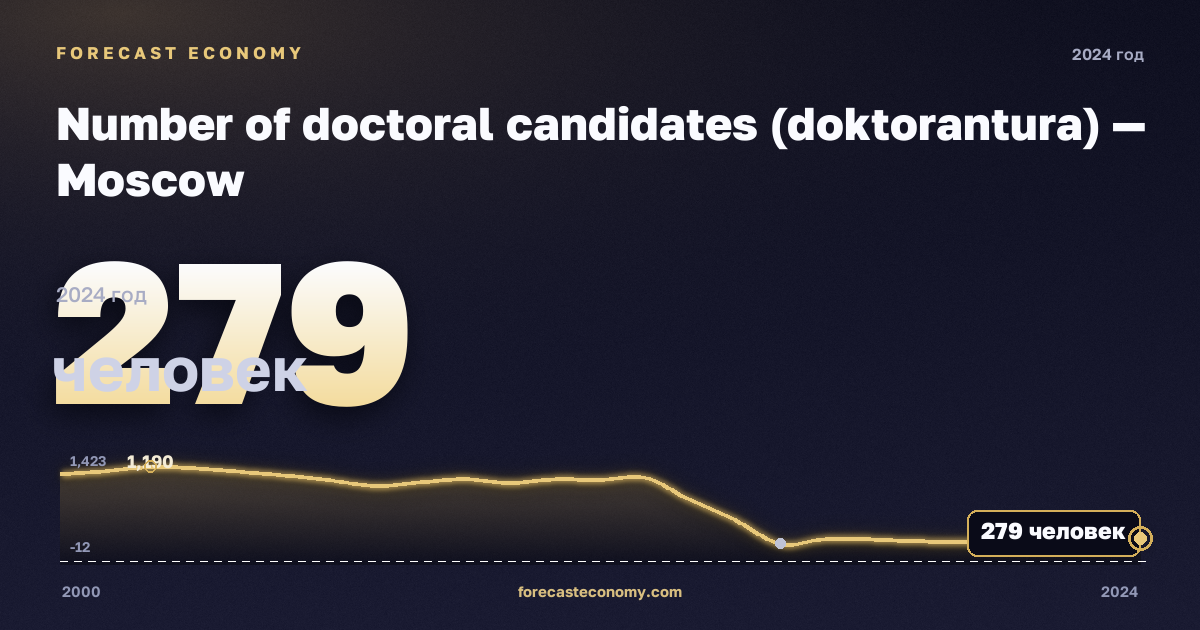
Number of doctoral candidates (doktorantura) in Moscow in 2024: 279 people. Over the year the indicator rose by 10,3%.
Over five years (since 2019) the indicator rose by 9,4%. Since 2000, the start of the available series, the indicator fell by 74,6% (from 1 099 to 279 people).
By this indicator Moscow is among the three regions with the largest values among 51 federal subjects in 2024 (table for all regions). The Russia-wide figure is 899 people: the region is below the national average.
Maximum over the full observation period — 1 190 people in 2002, minimum — 221 people in 2016. Data are updated annually as Rosstat releases the yearbook.
Number of doctoral candidates (doktorantura) in Moscow at checkpoint years
- 2000 — 1 099 people
- 2005 — 1 082 people
- 2010 — 986 people
- 2015 — 520 people
- 2020 — 250 people
- 2024 — 279 people
Number of doctoral candidates (doktorantura) by year
| Year | people |
|---|---|
| 2024 | 279 |
| 2023 | 253 |
| 2022 | 228 |
| 2021 | 234 |
| 2020 | 250 |
| 2019 | 255 |
| 2018 | 279 |
| 2017 | 281 |
| 2016 | 221 |
| 2015 | 520 |
| 2014 | 772 |
| 2013 | 1 053 |
| 2012 | 1 026 |
| 2011 | 1 035 |
| 2010 | 986 |
| 2009 | 1 035 |
| 2008 | 996 |
| 2007 | 950 |
| 2006 | 1 023 |
| 2005 | 1 082 |
| 2004 | 1 129 |
| 2003 | 1 173 |
| 2002 | 1 190 |
| 2001 | 1 135 |
| 2000 | 1 099 |
Questions and answers
What is “Number of doctoral candidates (doktorantura)” in Moscow?
According to Rosstat for 2024 — 279 people.
Where does Moscow sit in the list by indicator magnitude?
1 of 51 federal subjects when ordered by descending value for 2024.
How did the indicator change over the last year?
From 2023 to 2024 the indicator rose by 10,3%.
Where do the data come from and how often are they updated?
Source — the official Rosstat yearbook "Regions of Russia. Socio-economic indicators". Figures are annual and update after each new yearbook release.
This indicator in neighbouring regions of the district
- Number of doctoral candidates (doktorantura) — Belgorod Oblast
- Number of doctoral candidates (doktorantura) — Bryansk Oblast
- Number of doctoral candidates (doktorantura) — Vladimir Oblast
- Number of doctoral candidates (doktorantura) — Voronezh Oblast
- Number of doctoral candidates (doktorantura) — Ivanovo Oblast
- Number of doctoral candidates (doktorantura) — Kaluga Oblast
- Number of doctoral candidates (doktorantura) — Kostroma Oblast
- Number of doctoral candidates (doktorantura) — Kursk Oblast
- Number of doctoral candidates (doktorantura) — Lipetsk Oblast
- Number of doctoral candidates (doktorantura) — Moscow Oblast
- Number of doctoral candidates (doktorantura) — Oryol Oblast
- Number of doctoral candidates (doktorantura) — Ryazan Oblast
- Number of doctoral candidates (doktorantura) — Smolensk Oblast
- Number of doctoral candidates (doktorantura) — Tambov Oblast
- Number of doctoral candidates (doktorantura) — Tver Oblast
- Number of doctoral candidates (doktorantura) — Tula Oblast
- Number of doctoral candidates (doktorantura) — Yaroslavl Oblast
More in “Education”
- Number of postgraduate research students (aspirantura)
- Enrolment in general education organizations
- Clinical residents and trainee assistants — trainee assistants
- Clinical residents and trainee assistants — residents
- Academic teaching staff in higher education programmes
- Students in state and municipal mid-level specialist programmes per 10,000 population
- Students in bachelor's, specialist and master's programmes
- Students in bachelor's, specialist and master's programmes per 10,000 population
- Students in skilled worker and employee training programmes
- Students in mid-level specialist training programmes
Data source
Rosstat yearbook "Regions of Russia. Socio-economic indicators". Values for 2000–2024, units: people. Each region has a page with the full indicator series since 1990.